Welcome to the Inside
The night I got my first push notification from an app I built — and realized the locked doors were all open.

For years I had app ideas. Doesn’t everyone? Whole apps, fully formed in my head, that I was sure I’d never build. Writing iOS code looked impossible — I didn’t have the time, and honestly I was afraid I didn’t have the wherewithal. The ideas just sat there behind glass.
Then I started building with Claude Code, and a couple of apps came together in about two days each. The impossible started looking attainable. Which is how I ended up thinking about push notifications.
We were mapping out the customer app for the wine shop — Thick as Thieves — and what it should actually *do* for people. Tell a regular when a new vintage of something they’ve bought before drops. Ping someone when a bottle they wanted is back in stock. Run our allocation list. All of it needs the same thing: a way to reach into a customer’s day and tap them on the shoulder.
I didn’t know the first thing about how Apple does that. Claude walked me through it: a closed app is basically frozen, so the notification can’t come *from* the app — it has to ride a rail outside it, hit Apple’s servers, and travel back to light up the phone and pull the person in. Once it was explained, it made sense. (Most of this does, after someone explains it. That’s kind of the whole story.)
Then we hit a fork. Claude pushed me toward a paid third-party push service — better segmentation, A/B testing, all the bells. And here’s where the thing I *actually* know kicked in. In my other life I’m a data guy — casino consulting — and segmentation is my native language. So I pushed back: we already have our customer segments, or we can build them in Supabase. What exactly am I paying this company for? Claude thought about it and said… yeah, fair. Free and native was the right call.
That’s the part nobody tells you: **the AI writes the code, but you still have to know which question to ask.** I’m a four-day coder — I am *not* the one who should be choosing the architecture. But I’m the one who knew the segmentation question, because that’s mine. That’s the part I brought.
So there I am on the couch, watching a movie with my wife, and Claude says: alright, go set these things up. Step by step. Check this box, flip that setting, this entitlement here. It’s not hard — it just wants you to pay attention. Claude wired up a function to actually fire the notification, and said: okay, we’re live. Let’s test it.
The app wasn’t even in TestFlight. I’d loaded it onto my phone straight from my MacBook. Start to finish, the whole thing took about thirty minutes.
At 11:59 PM, my phone buzzed.
> **Welcome to the inside, Kyle 🥂**
> Push is live on Thick as Thieves — and you built the road this just traveled.
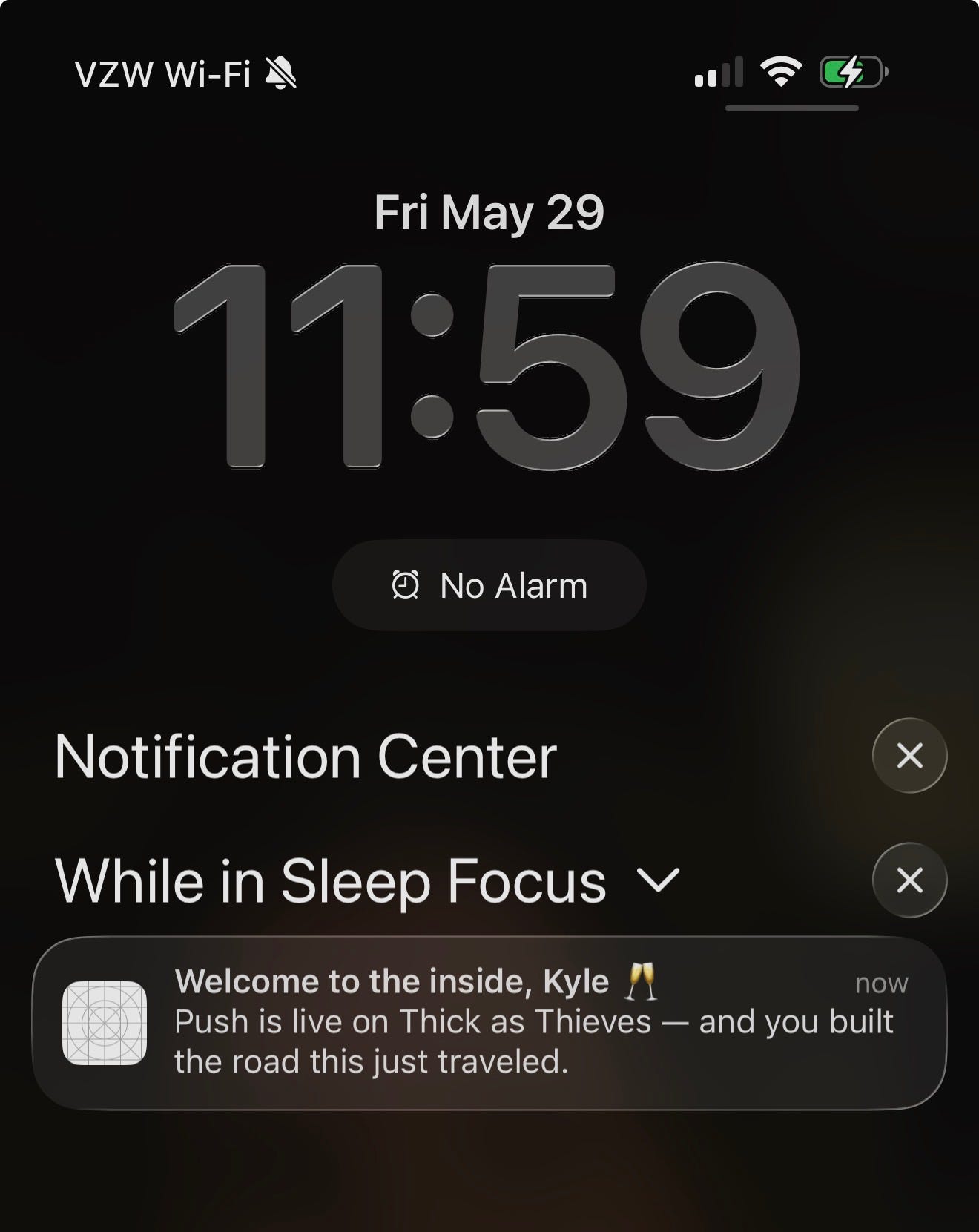
I took a screenshot like a kid. I sent it to my wife. I sent it to my group chat of college buddies — my nerd friends — *look, I have an app that does this now.* They got genuinely excited for me.
And I went to bed feeling like a hundred locked doors had clicked open at once.
The way I describe it: it’s the master key in Zelda. For most of the game you run around collecting one key for one lock, one key for one lock. Then you get the master key, and you just… open everything. Your brain stops asking *gosh, I wish I could do that too* and starts asking *what do I want to build next?* That’s a genuinely liberating place to stand.
It’s not all magic. Claude and I don’t always see the whole board — sometimes it’ll engineer a beautiful solution to exactly the wrong-sized problem, and one of us has to say *wait, step back, look at the whole thing.* That part is real, and I’ll write about it plenty here.
But that night was just the simple, stupid joy of a thing working. A notification. One buzz. I know how small that sounds. I don’t care. It’s true.
The doors are open now.
— Kyle
*I dictated this in the seam of real work; Claude helped me shape it. The voice and the judgment are mine.*